Instrumentation · temperatureSubscription
Thermocouple calculator: mV, temperature and cold junction compensation
Convert temperature to millivolts and millivolts to temperature for the eight standard types (B, E, J, K, N, R, S and T) with the NIST ITS-90 reference functions, with the cold junction you enter, the local sensitivity and the cable colour guide.
Subscription tool
Read the explanation and the example freely. To use the tool with your own data, log in to an account with active access or subscribe.
Read the explanation and the example freely. To use the tool with your own data, log in to an account with active access.
Want to check the quality first? Free, no sign-up: 4–20 mA calculator · residential cable sizing (whole house)
 Enlarge
Where it helps at work
- Check the voltage of an installed thermocouple with a multimeter.
- Simulate a thermocouple with a mV calibrator to test a transmitter or input card.
- Understand a reading difference caused by the cold junction or by double compensation.
- Identify the thermocouple type by the extension cable colours.
What you enter
What you get
Worked example: forgotten cold junction on a type K thermocouple
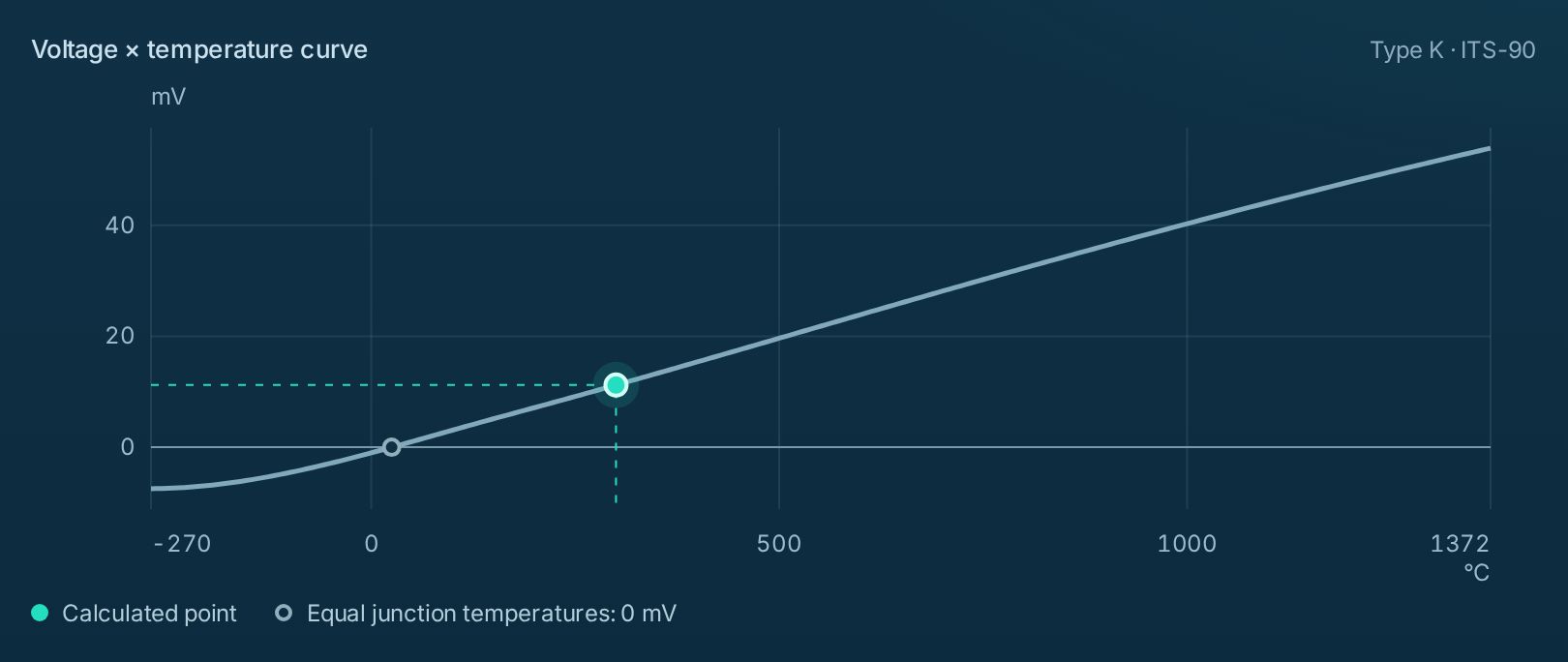
A type K thermocouple measures 300 °C in a furnace. The terminals where it connects to the instrument (the cold junction) are at 25 °C. What voltage does the multimeter read at the terminals, and what temperature would be shown if that voltage were converted as if the cold junction were at 0 °C?
| Type | K |
|---|---|
| Hot junction | 300 °C |
| Cold junction (terminals) | 25 °C |
| Reference voltage at 0 °C | 12.209 mV |
|---|---|
| Cold junction voltage | 1.000 mV |
| Voltage measured at the terminals | 11.208 mV |
| Local sensitivity | 41.4 µV/°C |
| Reading without cold junction compensation | 275.8 °C |
How to read it
From the 0 °C reference table, type K produces 12.209 mV at 300 °C, but the cold junction at 25 °C already "takes" 1.000 mV. The multimeter reads only the difference, 11.208 mV. Converted without compensation, that voltage indicates 275.8 °C, about 24.2 °C below the real value. Correct compensation adds the cold junction voltage before converting: it adds voltages, not temperatures. Near 300 °C each °C is worth about 41.4 µV, so a few millivolts of error already become tens of degrees.
Limits and cautions
- Nominal ITS-90 functions: they do not include sensor tolerance, drift, extension cable errors or instrument uncertainty.
- The mathematical range of the curve is not the sensor operating range; check construction, atmosphere and manufacturer limits.
- For type B, conversion from mV to temperature is limited to 250…1820 °C.
- A voltage already compensated to 0 °C must be used with a cold junction of zero, to avoid compensating twice.
Technical basis
NIST ITS-90 reference functions (Monograph 175) for the eight standard types, with cold junction compensation.
- NIST Monograph 175 — thermocouple reference functions (ITS-90)
- IEC 60584-1 — thermocouples: specifications and tolerances
- IEC 60584-3 and ANSI MC96.1 — extension and compensating cable colors
In the full version, you can
- Convert both ways for the eight types, with the real cold junction.
- See the curve shifted by the cold junction and the sensitivity at each point.
- Pick the type by the cable colours and copy the reference table.
- Export an unbranded PDF report with TAG and person responsible, and keep the work on your device or in your account.
ALOGY Tools subscription
One plan unlocks every subscription tool, with PDF reports and work kept in your account, to open on your phone and computer.
- Every subscription tool, in Portuguese, English and Spanish
- Pix or card on Asaas’s secure page, no boleto
- 7 days to withdraw with a full refund; after that, cancel renewal whenever you want
Frequently asked questions
Can I add the cold junction temperature to the reading?
No. The thermocouple curve is not linear: compensation adds voltages, not temperatures. Convert the cold junction temperature to mV, add it to the measured voltage and only then convert to temperature.
How can I tell the type from the cable?
By the colours of the jacket and conductors, which differ between IEC and ANSI. The tool has a guide to the eight types, but colour alone is not enough: confirm on the label or drawing.
Why did the reading drop when the panel heated up?
If the cold junction compensation does not follow the real terminal temperature, each degree of difference at the terminals becomes a reading error. Measure the terminal temperature and compare.
Related tools
Related tables and guides
- Type K thermocouple table: mV vs °C (−270 to 1372 °C)
- Type J thermocouple table: mV vs °C (−210 to 1200 °C)
- Type T thermocouple table: mV vs °C (−270 to 400 °C)
- Type E thermocouple table: mV vs °C (−270 to 1000 °C)
- Type N thermocouple table: mV vs °C (−270 to 1300 °C)
- Type R thermocouple table: mV vs °C (−50 to 1768.1 °C)
- Type S thermocouple table: mV vs °C (−50 to 1768.1 °C)
- Type B thermocouple table: mV vs °C (0 to 1820 °C)
- Thermocouple wire color codes: IEC and ANSI