ConversionsSubscription
Industrial unit converter: pressure, flow, power and more
Convert 16 quantities used in industry, from pressure and flow to torque, energy, density and viscosity, with the same value shown in every unit of the quantity and factors from the official definitions.
Subscription tool
Read the explanation and the example freely. To use the tool with your own data, log in to an account with active access or subscribe.
Want to check the quality first? Use the 4–20 mA calculator for free
Where it helps at work
- Read manuals and nameplates of imported equipment in psi, gpm, hp or BTU.
- Check transmitter and gauge ranges written in different units.
- Turn L/min into m³/h or cfm when comparing pumps and compressors.
- Convert viscosity in cP and cSt from oil data sheets.
What you enter
What you get
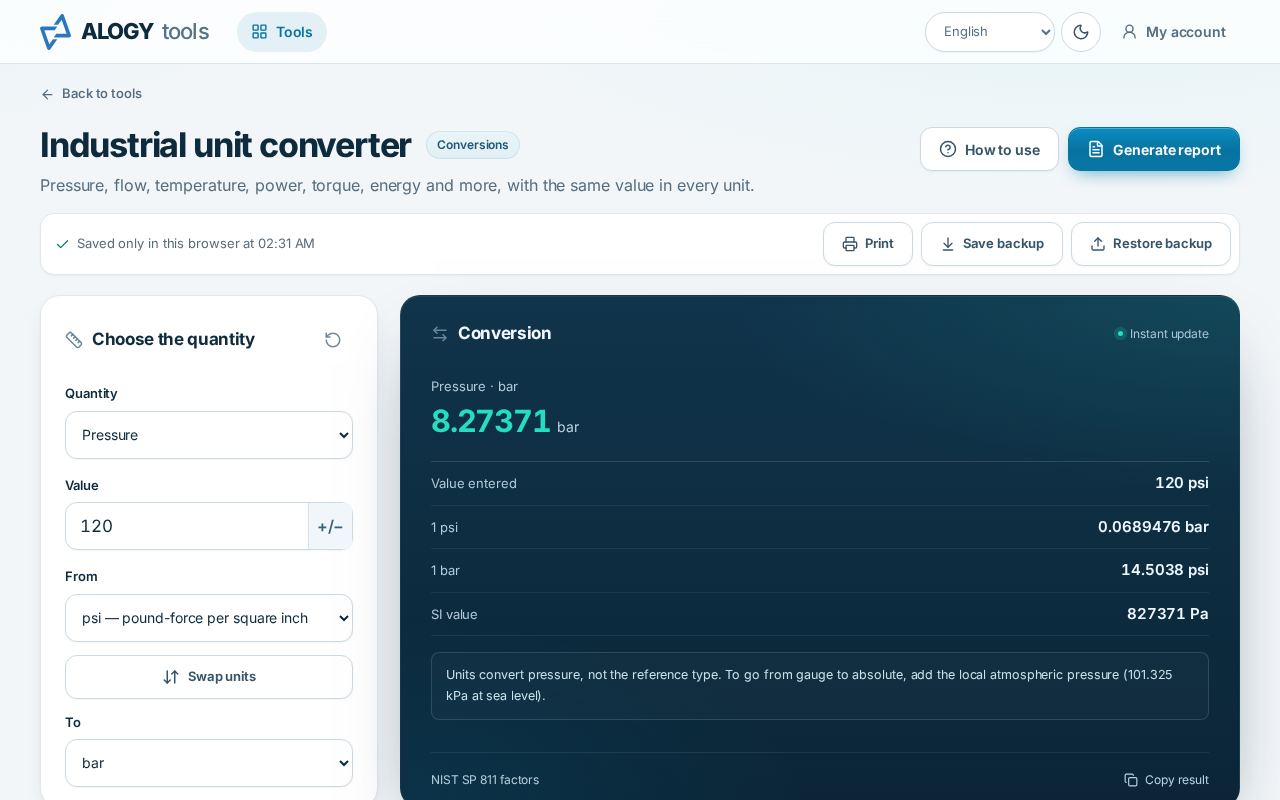
Worked example: pressure of an imported compressor
An imported compressor has its relief pressure set at 120 psi. The plant air line has valves and gauges rated in bar, and the old panel shows kgf/cm². How much is that in each unit?
| Value entered | 120 psi |
|---|
| bar | 8.27371 bar |
|---|---|
| kgf/cm² | 8.43683 kgf/cm² |
| kPa | 827.371 kPa |
| MPa | 0.827371 MPa |
How to read it
The 120 psi equal 8.27371 bar. A line valve rated for 8 bar would be below that pressure; the compressor must be reset or the valve replaced. A gauge in kgf/cm² would read 8.43683, close to bar but not equal: 1 kgf/cm² is 0.980665 bar.
Limits and cautions
- Converting the unit does not change the reference: gauge pressure stays gauge. For absolute, add the local atmospheric pressure.
- Water and mercury columns use conventional densities; real manometers depend on the liquid temperature.
- Gas volume flow does not become normal flow by changing the unit; use the gas flow normalization tool for that.
Technical basis
Conversion factors from NIST SP 811 and the definitions of the International System.
- NIST SP 811 (2008) — Guide for the Use of the International System of Units
- BIPM — The International System of Units (SI), 9.ª edição
In the full version, you can
- Convert any of the 16 quantities with your values, including negative ones.
- See the same value in every unit of the quantity at once.
- Export the PDF with the value and the unit table.
- Keep the work on your device and restore it from a backup.
ALOGY Tools subscription
One plan unlocks every subscription tool, with PDF reports and saving on your device.
- Every subscription tool, in Portuguese, English and Spanish
- Pix, card or boleto on Asaas’s secure page
- 7 days to withdraw with a full refund; after that, cancel renewal whenever you want
Payments in test mode: nothing is charged for now.
Log in to my accountFrequently asked questions
What is the difference between cv and hp?
cv is the metric horsepower, 735.5 W. hp is the mechanical horsepower, 745.7 W. The difference is about 1.4 %, which matters when comparing motors.
Is 1 kgf/cm² the same as 1 bar?
Not exactly: 1 kgf/cm² is 0.980665 bar. The 2 % difference shows up on gauges and pressure switch settings.
How do I convert °C to °F for a temperature difference?
Differences do not use the 32 offset: a 1 °C difference equals 1.8 °F and 1 K.
Can the results be copied?
Yes. The result has a copy button and the table with every unit goes into the PDF report.