Instrumentation · temperatureSubscription
PT100 calculator: resistance, temperature, leads and IEC 60751 class
Convert temperature to resistance and resistance to temperature for PT100, PT500 and PT1000 with the IEC 60751 Callendar–Van Dusen curve, see the effect of the leads in 2-wire connection and the tolerance of classes AA, A, B and C.
Subscription tool
Read the explanation and the example freely. To use the tool with your own data, log in to an account with active access or subscribe.
Read the explanation and the example freely. To use the tool with your own data, log in to an account with active access.
Want to check the quality first? Free, no sign-up: 4–20 mA calculator · residential cable sizing (whole house)
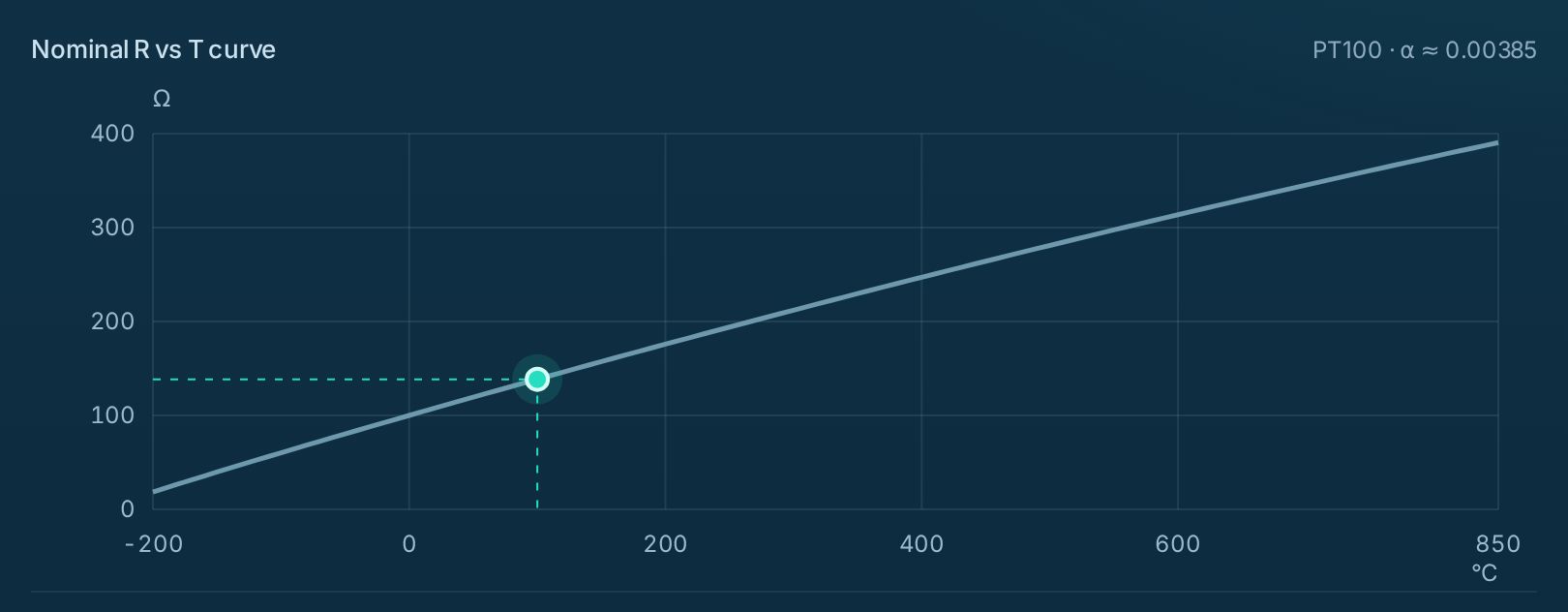 Enlarge
Where it helps at work
- Check with a multimeter whether a PT100 reads the right temperature.
- Simulate a sensor with a resistance decade to test a transmitter or input card.
- Assess the error of a 2-wire connection before deciding to change the cable.
- Know which tolerance the sensor class guarantees at the working temperature.
What you enter
What you get
Worked example: lead error in a 2-wire connection
A class B thin-film PT100 sensor measures 100 °C in a heat exchanger. It is wired with 2 wires to the panel, and each cable conductor has 0.5 Ω. What resistance does the instrument read, what temperature does it show without lead compensation, and how does that error compare with the class tolerance?
| Sensor | PT100 |
|---|---|
| Element temperature | 100 °C |
| Connection | 2-wire |
| Resistance per conductor | 0.5 Ω |
| Class and construction | Class B · thin film |
| Reading resistance | 139.5055 Ω |
|---|---|
| Temperature shown without compensation | 102.64 °C |
| Error if the leads are ignored | +2.638 °C |
| Class B tolerance at 100 °C | ±0.8 °C |
How to read it
The element has 138.5055 Ω at 100 °C, but the 2-wire instrument reads 139.5055 Ω because it adds the 1 Ω of both conductors. Without compensation, that reading corresponds to 102.64 °C: a +2.638 °C error caused by the cable alone, about 3.3 times the class B tolerance at that point (±0.8 °C). 3- or 4-wire connection, or lead resistance compensation in the instrument, removes most of that error.
Limits and cautions
- Nominal curve with α ≈ 0.00385 °C⁻¹; other platinum, nickel or copper curves are not included.
- It does not consider self-heating, insulation resistance, instrument uncertainty or conductor imbalance in 3-wire connection.
- Special classes and extended ranges declared by the manufacturer are not assessed.
- A valid conversion does not prove sensor conformity: that requires calibration.
Technical basis
Callendar–Van Dusen curve and tolerance classes of IEC 60751:2022, with the effect of 2-, 3- and 4-wire connection.
- IEC 60751:2022 — industrial platinum resistance thermometers
- Texas Instruments — RTD measurements (application note)
In the full version, you can
- Convert both ways for PT100, PT500 and PT1000.
- See the 2-wire lead error and the class tolerance at the point.
- Explore the curve with the slider and copy the reference table.
- Export an unbranded PDF report with TAG and person responsible, and keep the work on your device or in your account.
ALOGY Tools subscription
One plan unlocks every subscription tool, with PDF reports and work kept in your account, to open on your phone and computer.
- Every subscription tool, in Portuguese, English and Spanish
- Pix or card on Asaas’s secure page, no boleto
- 7 days to withdraw with a full refund; after that, cancel renewal whenever you want
Frequently asked questions
How many ohms does a PT100 have at 100 °C?
Per IEC 60751, 138.5055 Ω. At 0 °C it is 100 Ω; each degree above adds about 0.385 Ω near 0 °C, a little less at high temperatures.
Does 3-wire connection remove the lead error?
Almost all of it, as long as the three conductors have the same resistance and the instrument is compatible. Conductor imbalance is not calculated by the tool.
Does the class apply at any temperature?
No. Each class has a validity range that depends on the element construction. Classes AA and A do not apply to 2-wire connection.