Residential electricsSubscription
Residential cable sizing: cable, breaker and RCD to Brazilian NBR 5410
Choose the type of circuit of the house or flat — shower, outlets, lighting, air conditioner, oven — and get the cable, the breaker, the RCD, the protective conductor and the conductor colours, with the circuit diagram and the voltage drop.
Subscription tool
Read the explanation and the example freely. To use the tool with your own data, log in to an account with active access or subscribe.
Want to check the quality first? Use the 4–20 mA calculator for free
 Enlarge
Where it helps at work
- Replace a shower with a more powerful one and know whether the cable and breaker can take it.
- Plan the circuits of a refurbishment: kitchen, service area, air conditioning and outlets.
- Check whether the RCD is required on the circuit and which current it needs.
- Show the client, with the diagram, why the cable has to be larger.
What you enter
What you get
Worked example: 5500 W shower at 220 V
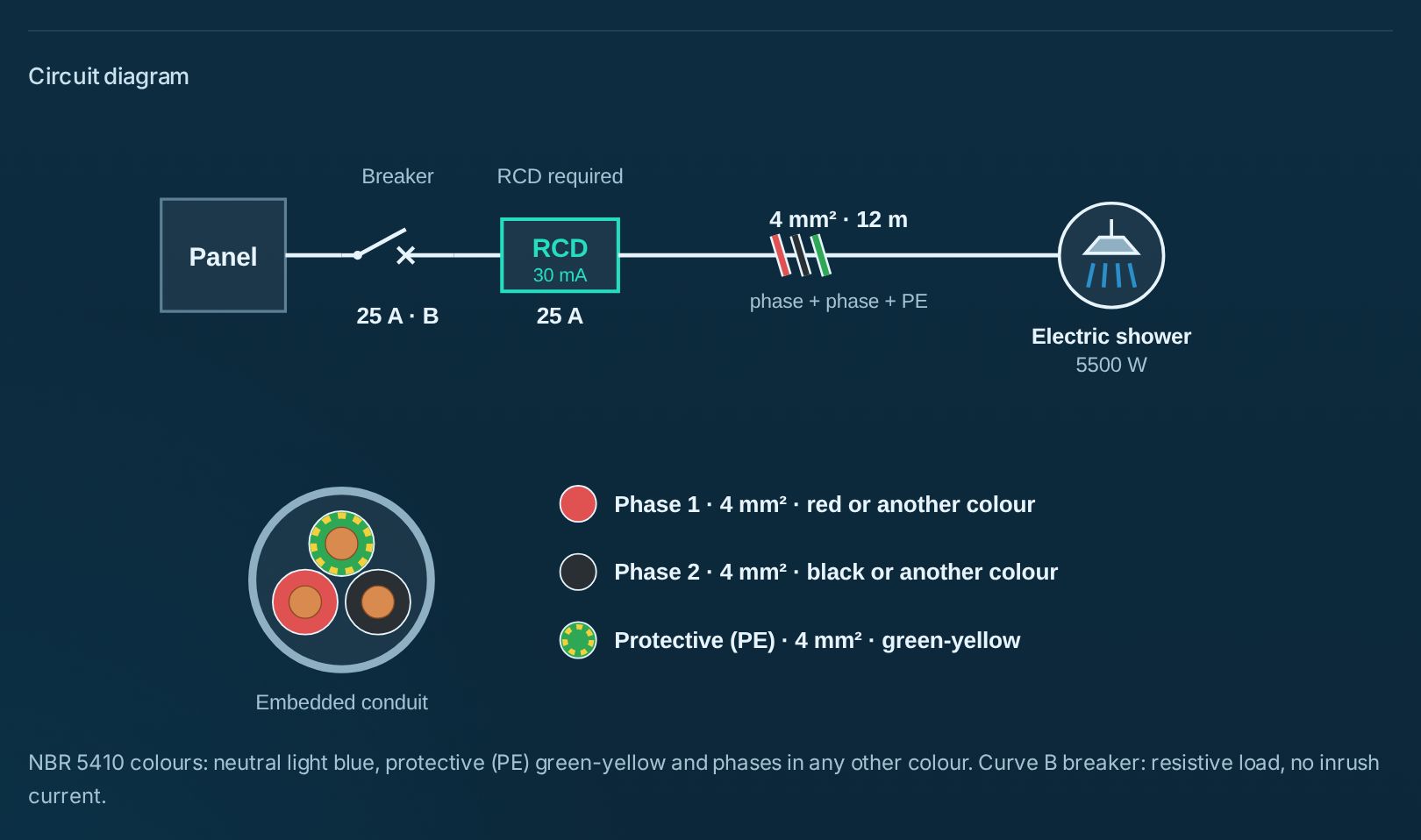
A 5500 W electric shower at 220 V (two phases) is in the bathroom, 12 m from the panel. The conductors run alone in a conduit embedded in the wall, at 30 °C. Which cable, breaker and RCD?
| Circuit | Electric shower |
|---|---|
| Room | Bathroom |
| Supply | 220 V · phase and phase |
| Power | 5500 W |
| Length (one way) | 12 m |
| Installation | Embedded in conduit (B1) |
| Design current | 25 A |
|---|---|
| Cable | 4 mm² |
| Breaker | 25 A · curve B · two-pole |
| Residual-current device | 30 mA · 25 A · required |
| Corrected cable capacity | 32 A |
| Voltage drop | 3.09 V (1.41 %) |
How to read it
A 2.5 mm² cable would carry only 24 A, less than the 25 A breaker: the current-carrying capacity leads to the 4 mm² cable. The 1.41 % drop is well below the 4 % of a final circuit, and the 30 mA RCD is required because it is a bathroom.
Limits and cautions
- Single-phase and two-phase copper circuits with PVC insulation, up to 63 A, as in houses and flats. For three-phase circuits and motors, use the industrial cable sizing.
- It does not check short circuit, selectivity, earthing, the main panel or the feeder from the meter.
- It is a design aid: it does not replace the electrical design signed by a responsible engineer.
Technical basis
Brazilian NBR 5410 (aligned with IEC 60364): current-carrying capacity with temperature and grouping corrections, minimum sections, coordination with the breaker (NBR NM 60898), voltage drop, 30 mA RCD and conductor colours.
- ABNT NBR 5410 — low-voltage electrical installations
- ABNT NBR NM 60898 — circuit-breakers for household installations
- IEC 60364-5-52 — selection and erection of wiring systems
In the full version, you can
- Size showers, faucets, outlets, lighting, air conditioners, ovens and other appliances at 127 or 220 V.
- See the diagram with the symbols and the conduit cross-section with the conductor colours.
- Compare the sections checked by capacity and by voltage drop.
- Export an unbranded PDF report and keep the work on your device, with a backup file.
ALOGY Tools subscription
One plan unlocks every subscription tool, with PDF reports and saving on your device.
- Every subscription tool, in Portuguese, English and Spanish
- Pix or card on Asaas’s secure page, no boleto
- 7 days to withdraw with a full refund; after that, cancel renewal whenever you want
Frequently asked questions
Can I use a larger breaker so it does not trip?
No. The breaker protects the cable: it must be at most the current the cable can carry. If it trips, the circuit needs a larger cable or another split of the loads.
Does the RCD replace the breaker?
No. The RCD protects people against electric shock; the breaker protects the cable against overload and short circuit. Where the standard requires it, both are used together.
Why did my shower cable come out larger than usual?
Because the tool checks the current the cable carries embedded in the wall, with grouping and temperature, and the voltage drop over the real length.