Instrumentation · levelSubscription
DP transmitter range for level: LRV, URV, dry leg and wet leg
Calculate the LRV and URV of a differential pressure transmitter that measures level in an open tank, a closed tank with a dry leg or a closed tank with a wet leg, or of a submersible hydrostatic probe, with the heights measured from the tank bottom (0 % and 100 % levels, high-side tap or probe tip, transmitter), the product density and the 4–20 mA signal at any level.
Subscription tool
Read the explanation and the example freely. To use the tool with your own data, log in to an account with active access or subscribe.
Read the explanation and the example freely. To use the tool with your own data, log in to an account with active access.
Want to check the quality first? Free, no sign-up: 4–20 mA calculator · residential cable sizing (whole house)
 Enlarge
Where it helps at work
- Configure a new DP transmitter before plant start-up.
- Understand why a level meter with a wet leg shows negative values.
- Recalculate the range after changing the tank product (another density).
- Check in the field the relationship between level, differential pressure and current during a loop check.
What you enter
What you get
Worked example: closed tank with a wet leg
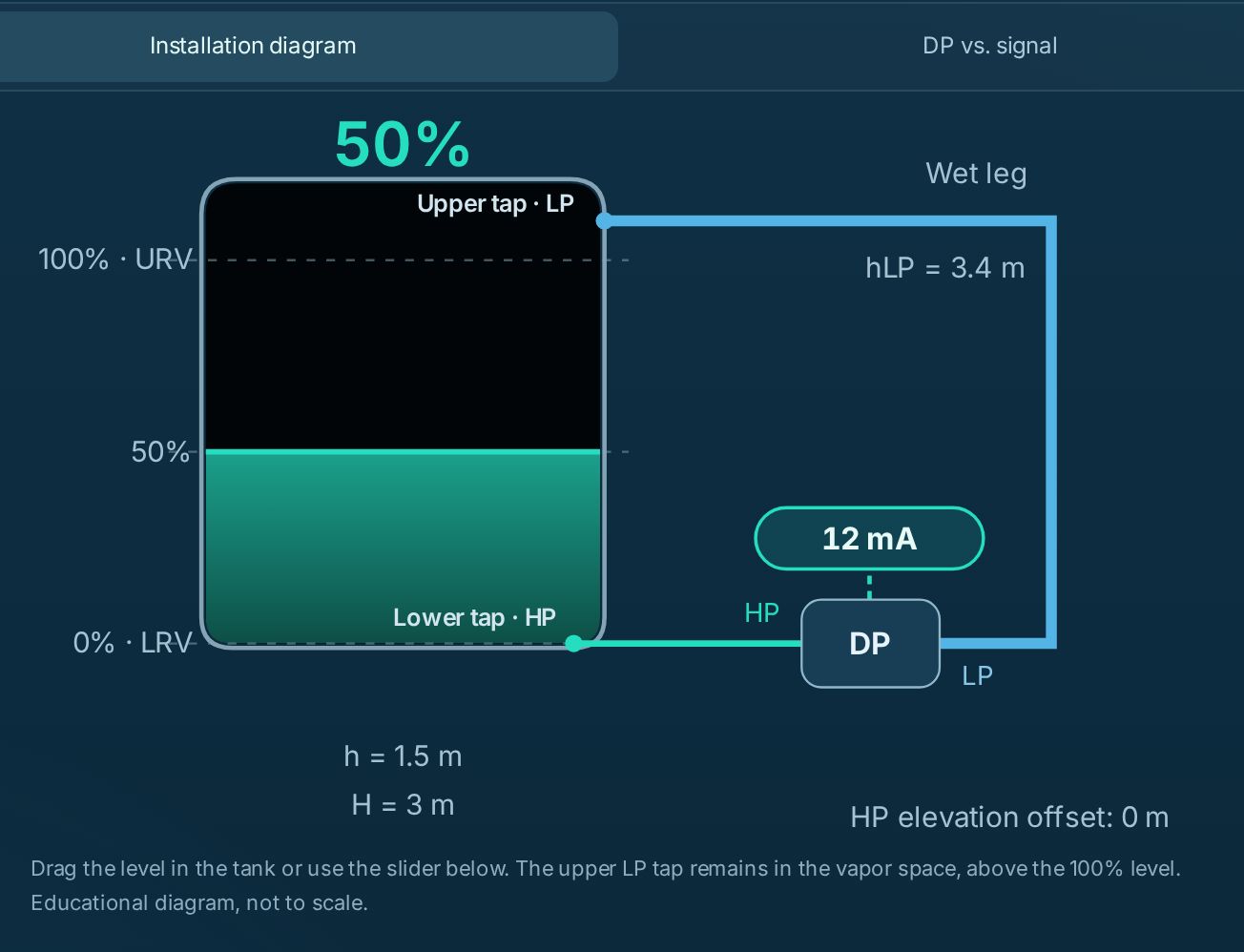
A closed tank with vapour at the top measures level with a differential pressure transmitter and a wet leg (seal filled with water, 1000 kg/m³) on the low side, 3.4 m above the high-side tap. The product has 950 kg/m³ and the measuring range is 3 m from the high-side tap. Which LRV and URV should be configured, and what does the transmitter show with the tank half full?
| Application | Closed tank, wet leg |
|---|---|
| Measuring height | 3 m |
| Product density | 950 kg/m³ |
| Wet leg: height | 3.4 m |
| Wet leg: density | 1000 kg/m³ |
| Level | 50 % |
| LRV (0 %) | -33.34 kPa |
|---|---|
| URV (100 %) | -5.394 kPa |
| Differential pressure at 50 % | -19.37 kPa |
| Signal at 50 % | 12 mA |
How to read it
The wet leg pushes on the low side with 33.34 kPa all the time, so the differential pressure is negative over the whole range: LRV = -33.34 kPa (empty tank) and URV = -5.394 kPa (full tank). The span is still the weight of the product column, 27.95 kPa. With the tank half full, the transmitter sees -19.37 kPa and sends 12 mA. A common mistake is configuring 0 to 27.95 kPa as for an open tank: with that range the transmitter would sit saturated below 4 mA at every level.
Limits and cautions
- Densities are taken as constant; temperature changes in the product or the seal change the measurement and must be assessed separately.
- Remote seals with capillaries, high static pressures and capillary temperature effects are not modelled.
- It does not read or configure the transmitter: you type the values into the instrument or configurator.
- Tanks with a two-liquid interface need their own calculation.
Technical basis
Hydrostatic pressure with standard gravity for open tanks, dry legs, wet legs and submersible probes with a vented cable, and a linear 4–20 mA signal.
- IEC 60381-1 — 4–20 mA analog signals
- Liptak, B. G. — Instrument Engineers’ Handbook, vol. 1: level measurement by differential pressure
- CGPM — standard gravity gₙ = 9.80665 m/s²
In the full version, you can
- Calculate the range for open tank, dry leg and wet leg with your data.
- Start from level, height, differential pressure or current and see the other values.
- See the tank diagram, the DP × signal curve and the 0 to 100 % table.
- Export an unbranded PDF report and keep the work on your device or in your account, to open it on another device.
ALOGY Tools subscription
One plan unlocks every subscription tool, with PDF reports and work kept in your account, to open on your phone and computer.
- Every subscription tool, in Portuguese, English and Spanish
- Pix or card on Asaas’s secure page, no boleto
- 7 days to withdraw with a full refund; after that, cancel renewal whenever you want
Frequently asked questions
Why is the LRV negative?
Because the wet leg exerts a constant pressure on the low side, larger than the product pressure with the tank empty. That is the correct result: the transmitter accepts a range with negative values, known as zero suppression or elevation.
Dry leg or wet leg?
A dry leg works when the top gas does not condense in the low-side piping. With steam or condensable gases the piping fills with liquid over time; in that case the leg is filled on purpose (wet leg) to keep the reference constant.
Does density change the range?
Yes. The span is proportional to the product density. Changing the tank product without reconfiguring the transmitter shifts the indicated level.