Fluids and piping · levelSubscription
Tank volume: vertical, horizontal, heads and strapping table
Calculate the total volume and the volume at a level of vertical, horizontal and rectangular tanks, with flat, elliptical, hemispherical or conical heads. The geometric strapping table helps linearize the level in the transmitter or the SCADA.
Subscription tool
Read the explanation and the example freely. To use the tool with your own data, log in to an account with active access or subscribe.
Want to check the quality first? Use the 4–20 mA calculator for free
Where it helps at work
- Turn a level reading into product volume for inventory or internal transfer.
- Build the linearization table of a level transmitter on a horizontal tank.
- Know how much fits up to the high-level alarm before scheduling a delivery.
- Convert volume to mass with the product density to check balances.
What you enter
What you get
Worked example: vertical tank with elliptical heads
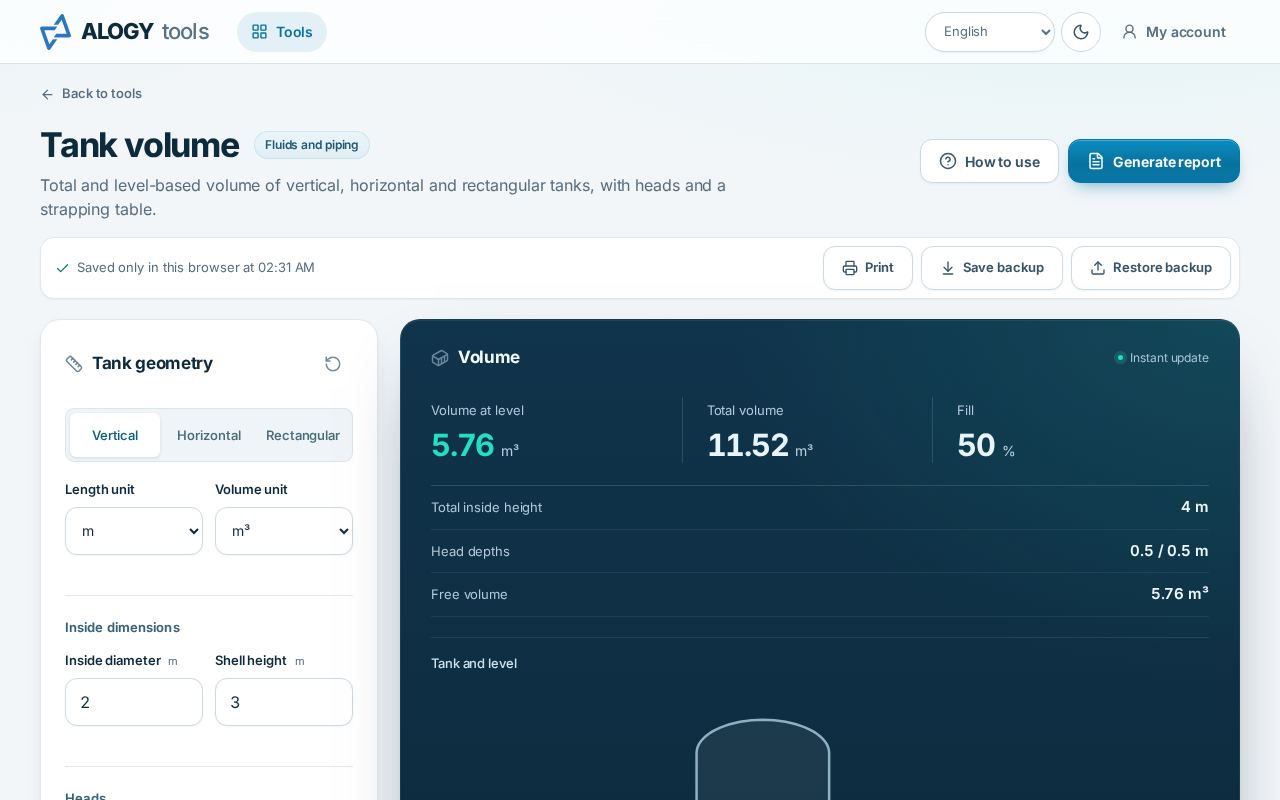
A vertical tank has a 2 m inside diameter, a 3 m straight shell and 2:1 elliptical heads at the bottom and top. The level transmitter reads 2 m, measured from the lowest point of the bottom. How much product is in the tank?
| Shape | Vertical cylindrical |
|---|---|
| Inside diameter | 2 m |
| Shell height | 3 m |
| Heads (bottom and top) | 2:1 elliptical |
| Level | 2 m |
| Volume at level | 5.76 m³ |
|---|---|
| Total volume | 11.52 m³ |
| Fill | 50 % |
| Total inside height | 4 m |
| Free volume | 5.76 m³ |
How to read it
At 2 m there are 5.76 m³ out of 11.52 m³ (50 %). The total inside height is 4 m, because each 2:1 head adds 0.5 m. Note the strapping table: at 10 % of the height (0.4 m) there is only 6.4 % of the volume, because the curved bottom holds little product. That is why volume must not be computed as level × area in tanks with heads.
Limits and cautions
- Torispherical heads (ASME F&D) are not modelled; the 2:1 elliptical is an approximation to check against the drawing.
- It is a geometric volume: it ignores deformation, tilt, coils, agitators, thermal expansion and foam.
- Custody-transfer or fiscal tanks need the official strapping, done by measurement.
Technical basis
Geometry of cylinders and flat, 2:1 elliptical, hemispherical and conical heads; geometric strapping table, without the corrections of a physical strapping.
- Geometria do elipsoide de revolução e do segmento circular (fórmulas fechadas)
- API MPMS cap. 2 — arqueação de tanques (para custódia, feita por medição)
In the full version, you can
- Calculate vertical, horizontal and rectangular tanks with your data and heads.
- Explore the level on the tank drawing and see the volume change instantly.
- Get the geometric strapping table and the product mass.
- Export the PDF with geometry, drawing and table; save and restore the work.
ALOGY Tools subscription
One plan unlocks every subscription tool, with PDF reports and saving on your device.
- Every subscription tool, in Portuguese, English and Spanish
- Pix, card or boleto on Asaas’s secure page
- 7 days to withdraw with a full refund; after that, cancel renewal whenever you want
Payments in test mode: nothing is charged for now.
Log in to my accountFrequently asked questions
Where is the level measured from?
From the lowest inside point of the tank, including the bottom head. If the transmitter is above that point, add the offset before entering it.
Is half the height half the volume?
Only in symmetrical shapes, such as a horizontal tank or a vertical one with equal heads. With a conical bottom, half the height holds well under half the volume.
Can I use the table in the transmitter?
Yes: the geometric strapping table gives the level × volume pairs for linearization. For custody transfer, use the official strapping.
Which units can I use?
Dimensions in m, mm, cm, ft or in and volumes in m³, L, US gallons, barrels or ft³.