Fluids and pipingSubscription
Flow × velocity × diameter: choosing the pipe by velocity
With two of the three values, calculate the third: mean velocity, flow or minimum inside diameter. The tool suggests the smallest ASME steel pipe that keeps the velocity within the limit and compares it with the usual range of the service, from pump suction to steam.
Subscription tool
Read the explanation and the example freely. To use the tool with your own data, log in to an account with active access or subscribe.
Want to check the quality first? Use the 4–20 mA calculator for free
Where it helps at work
- Pre-size a new line before the full pressure drop calculation.
- Check whether an existing pipe runs too fast after a production increase.
- Estimate the flow from a velocity measured with a portable meter.
- Explain to a supplier why the pump suction needs a larger pipe than the discharge.
What you enter
What you get
Worked example: sizing a discharge line
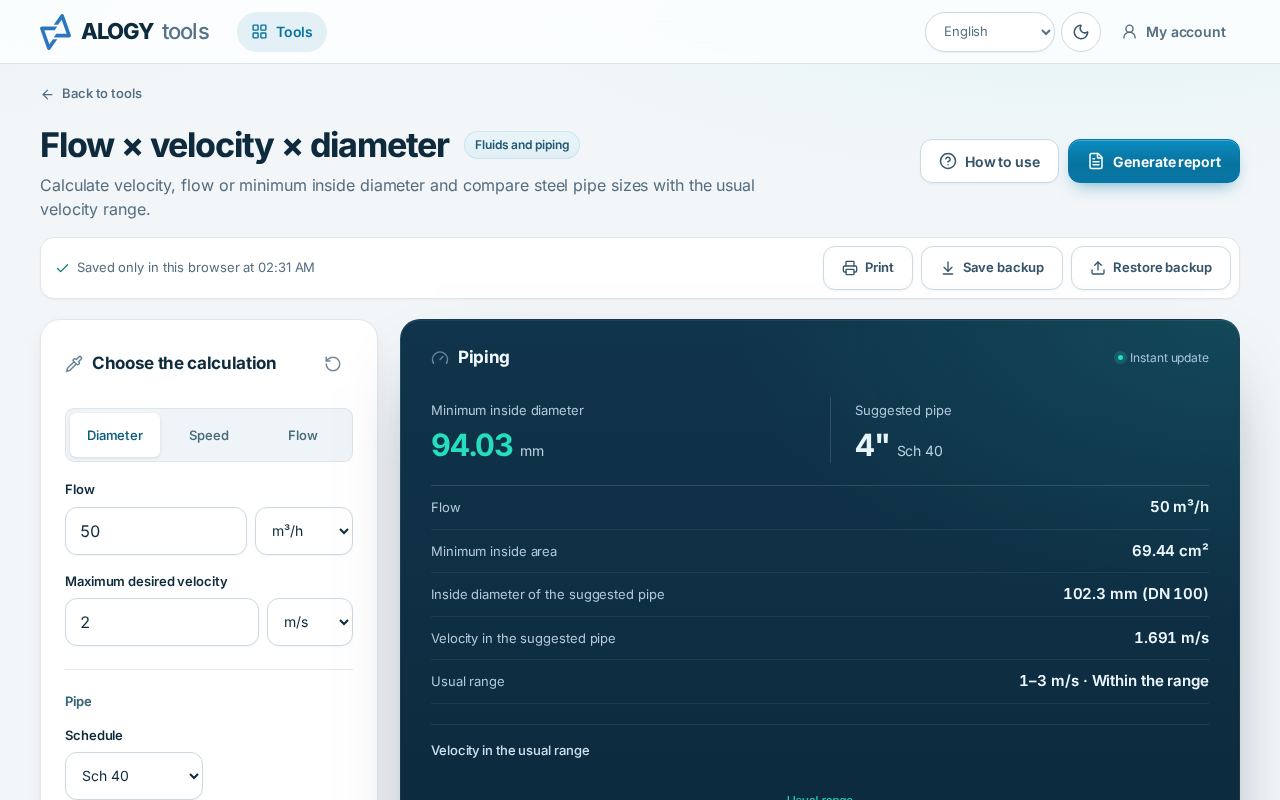
A new water discharge line will carry 50 m³/h. Company practice limits the velocity to 2 m/s. What is the minimum inside diameter and which schedule 40 steel pipe meets it?
| Solve for | Diameter |
|---|---|
| Flow | 50 m³/h |
| Maximum desired velocity | 2 m/s |
| Steel pipe | schedule 40 |
| Service | Water: pump discharge |
| Minimum inside diameter | 94.03 mm |
|---|---|
| Suggested pipe | 4" sch 40 |
| Suggested pipe inside diameter | 102.3 mm |
| Velocity in the suggested pipe | 1.69 m/s |
| Velocity in the 3" pipe | 2.91 m/s |
How to read it
The minimum inside diameter is 94.03 mm. The smallest pipe that meets it is 4" schedule 40, with 102.3 mm inside, where the water runs at 1.69 m/s, within the usual 1 to 3 m/s discharge range. The 3" pipe, one size below, would run at 2.91 m/s: still in range, but above the requested limit and with a much larger pressure drop. The pressure drop tool confirms the choice with the complete line.
Limits and cautions
- Velocity ranges are literature rules of thumb, not a standard: noise, erosion, NPSH and water hammer set the real limit of your project.
- The table covers ASME steel pipes from 1/2" to 12", schedule 40 and 80. For PVC, copper or DIN, enter the inside diameter.
- In gases the velocity changes along the line with pressure; use the flow at the real condition of the section.
- It does not calculate the pressure drop: use the pressure drop tool for the complete line.
Technical basis
Continuity equation, ASME B36.10M inside diameters and usual velocity ranges from the design literature.
- ASME B36.10M — tubos de aço soldados e sem costura
- Crane TP-410 — Flow of Fluids Through Valves, Fittings and Pipe
In the full version, you can
- Calculate velocity, flow or diameter with your data and units.
- Get the smallest steel pipe that meets it and the velocity in every size.
- Compare with the usual service range or your company’s range.
- Export an unbranded PDF report and keep the work on your device, with a backup file.
ALOGY Tools subscription
One plan unlocks every subscription tool, with PDF reports and saving on your device.
- Every subscription tool, in Portuguese, English and Spanish
- Pix, card or boleto on Asaas’s secure page
- 7 days to withdraw with a full refund; after that, cancel renewal whenever you want
Payments in test mode: nothing is charged for now.
Log in to my accountFrequently asked questions
Why does the pump suction use a lower velocity?
A high suction velocity increases the loss before the pump and reduces the available NPSH, which favours cavitation. That is why the usual suction range is 0.5 to 1.5 m/s.
Can I use the nominal diameter in the calculation?
No. The nominal diameter is only a name: a 4" schedule 40 pipe has 102.26 mm inside and schedule 80, 97.18 mm. The tool uses the inside diameter.
Is a low velocity also a problem?
It can be: the pipe is larger and more expensive than needed and, with suspended solids, deposits may form.