Fluids and pipingSubscription
Pipe pressure drop: Darcy-Weisbach, fittings and elevation
Calculate the pressure drop of a liquid, or of a gas with a small drop, in a full round pipe: straight pipe friction with the Colebrook-White factor, local losses of elbows and valves by K coefficient, and the elevation between inlet and outlet.
Subscription tool
Read the explanation and the example freely. To use the tool with your own data, log in to an account with active access or subscribe.
Want to check the quality first? Use the 4–20 mA calculator for free
Where it helps at work
- Estimate the head the pump must deliver before asking for a quote.
- Understand why the flow dropped after a line extension or a valve change.
- Compare two pipe diameters for the same flow.
- Check the pressure available at the end of a cooling water network.
What you enter
What you get
Worked example: pumping water to an elevated tank
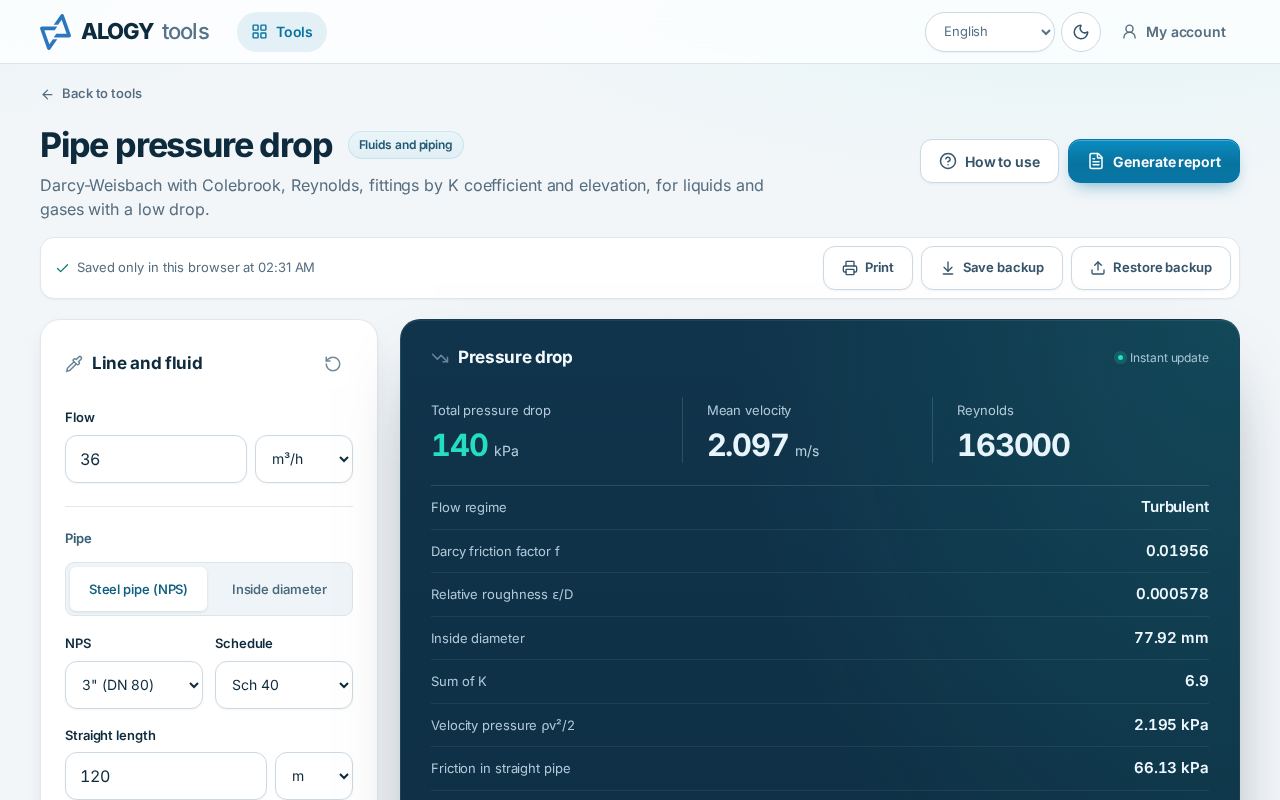
A pump delivers 36 m³/h of water at 20 °C through 120 m of new 3" schedule 40 carbon steel pipe (77.92 mm inside diameter) to a tank 6 m higher. Along the way there are 6 90° elbows, 2 gate valves and 1 check valve (ΣK = 6.9). How much pressure must the pump overcome in the line alone?
| Flow | 36 m³/h |
|---|---|
| Pipe | 3" sch 40 · 77.92 mm |
| Straight length | 120 m |
| Roughness | 0.045 mm |
| Fluid | Water at 20 °C |
| Elevation change | +6 m |
| Sum of K | 6.9 |
| Total pressure drop | 140 kPa |
|---|---|
| Straight pipe friction | 66.13 kPa |
| Fittings | 15.14 kPa |
| Elevation | 58.73 kPa |
How to read it
The line takes 140 kPa: 66.13 kPa of friction in the straight pipe, 15.14 kPa in the fittings and 58.73 kPa to lift 6 m. The 2.097 m/s velocity is within the usual discharge range, and the flow is turbulent (Re ≈ 163000). Since friction varies with about 1/D⁵, the same run in 4" would have only 16.95 kPa of friction: the tool’s diameter table, with the friction per 100 m, helps weigh pipe cost against pump energy.
Limits and cautions
- Incompressible fluid and full pipe. For gases it holds while the drop stays below about 10 % of the inlet absolute pressure.
- Roughness and K coefficients are typical literature values for new pipe and open valves; scaled pipes lose more.
- Between Re 2000 and 4000 the regime is uncertain; the tool uses the turbulent factor and warns.
- It does not select the pump nor check NPSH, water hammer or two-phase flow.
Technical basis
Darcy-Weisbach with the Colebrook-White friction factor, local losses by K coefficient and ASME B36.10M pipes.
- Crane TP-410 — Flow of Fluids Through Valves, Fittings and Pipe
- Colebrook, C. F. (1939) — Turbulent flow in pipes
- ASME B36.10M — tubos de aço soldados e sem costura
- IAPWS — propriedades da água
In the full version, you can
- Calculate your line with steel pipe by nominal size or with your own inside diameter.
- Count elbows, tees and valves and add the K of filters, exchangers and control valves.
- See the loss breakdown and the table of other diameters for the same flow.
- Export an unbranded PDF report and keep the work on your device, with a backup file.
ALOGY Tools subscription
One plan unlocks every subscription tool, with PDF reports and saving on your device.
- Every subscription tool, in Portuguese, English and Spanish
- Pix, card or boleto on Asaas’s secure page
- 7 days to withdraw with a full refund; after that, cancel renewal whenever you want
Payments in test mode: nothing is charged for now.
Log in to my accountFrequently asked questions
What is the difference between head loss and pressure drop?
Head loss is the energy dissipated by friction and fittings, here also in metres of fluid column. The total pressure drop adds the elevation, which is not a loss: it is energy stored in height.
Why does a larger pipe reduce the loss so much?
For the same flow the velocity falls with the square of the diameter, and the friction loss with about the fifth power. One size up usually halves the loss or better.
Can I use it for compressed air?
Yes, if the drop is small compared with the absolute pressure (up to about 10 %) and you enter the density at line pressure. For long lines, split them into sections.