Calibration · pH analysisSubscription
pH calibration sheet: buffers, temperature and field sheet in PDF
Prepare the check of pH meters and transmitters with the list of buffers used, the lot, expiry and certificate of each, and the record of reference, indication and temperature in each reading. Export the sheet as an unbranded A4 PDF.
Subscription tool
Read the explanation and the example freely. To use the tool with your own data, log in to an account with active access or subscribe.
Read the explanation and the example freely. To use the tool with your own data, log in to an account with active access.
Want to check the quality first? Free, no sign-up: 4–20 mA calculator · residential cable sizing (whole house)
 Enlarge
Where it helps at work
- Check the effluent, boiler or process pH analyser in routine maintenance.
- Record which buffer lots were used, for traceability.
- Compare the electrode response before and after cleaning or replacement.
- Standardize data collection between laboratory and field.
What you enter
What you get
Worked example: pH meter with three buffers
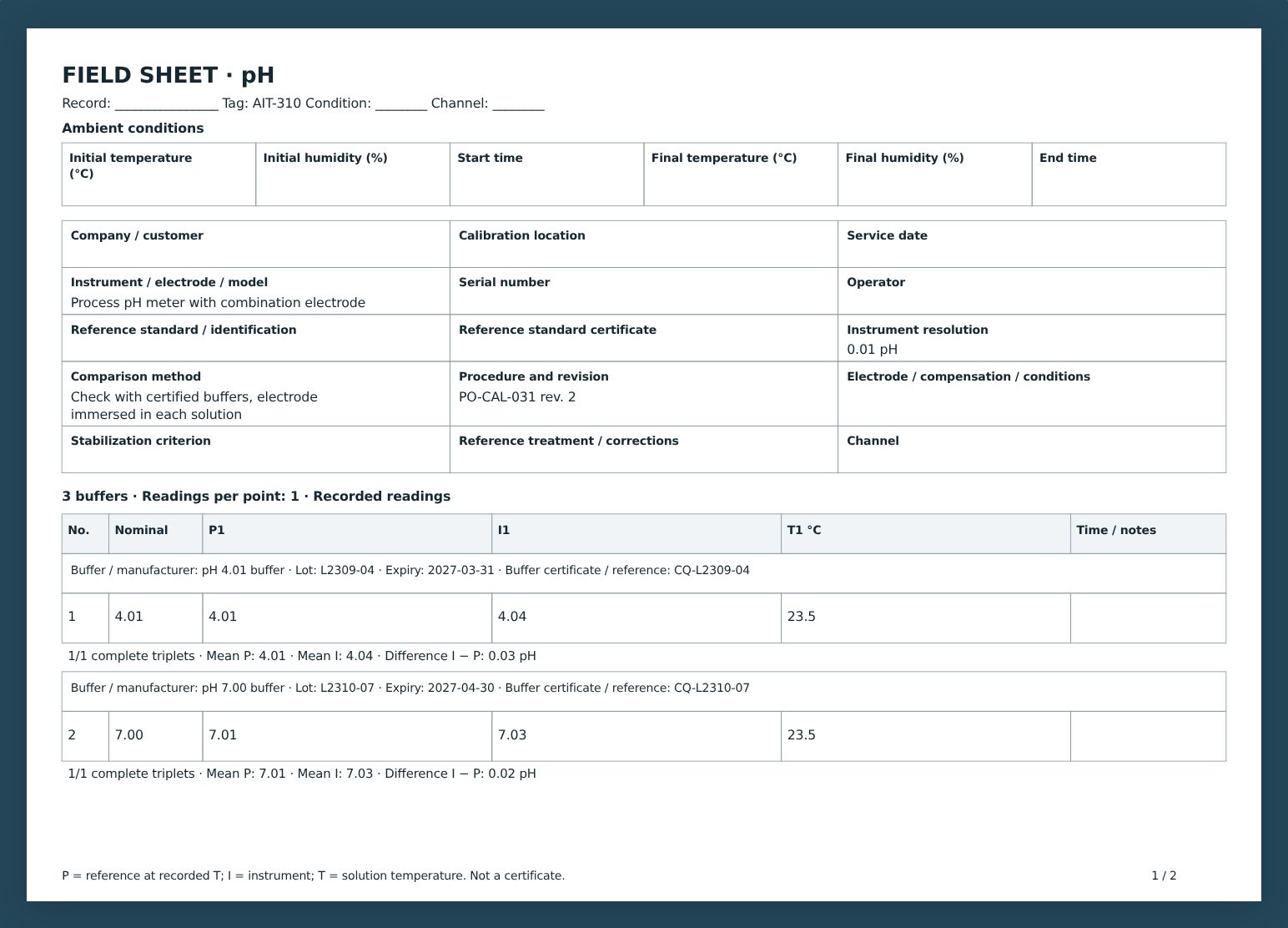
A process pH meter is checked with three certified buffers (pH 4.01; 7.00; 10.01). For each buffer the sheet records lot, expiry and certificate and, in each reading, the buffer reference pH at the solution temperature (P), the meter indication (I) and the temperature.
| Buffers | 4.01; 7.00; 10.01 |
|---|---|
| Readings per buffer | 1 |
| Decimals | 2 |
| Method | Check with certified buffers, electrode immersed in each solution |
| pH 4.01 buffer at 23.5 °C | P 4.01 · I 4.04 · I − P +0.03 |
|---|---|
| pH 7.00 buffer at 23.5 °C | P 7.01 · I 7.03 · I − P +0.02 |
| pH 10.01 buffer at 23.6 °C | P 10.04 · I 9.96 · I − P −0.08 |
How to read it
The acid and neutral buffers were within a few hundredths of the reference (+0.03 and +0.02); the alkaline one was −0.08. A deviation that shows only on the alkaline side usually points to loss of electrode slope or an alkaline buffer contaminated by CO₂ from the air. The sheet does not calculate the slope or decide: follow the procedure (recalibrate, replace the buffer or the electrode) and record a new sheet after adjustment. Note that P is the buffer value at 23.5 °C, taken from the certificate, not the nominal at 25 °C.
Limits and cautions
- It does not calculate electrode slope or offset, does not perform automatic temperature compensation and does not estimate uncertainty.
- It does not decide conformity and does not replace a calibration certificate.
- The buffer value at the use temperature comes from the manufacturer’s certificate and is typed by you.
- The draft stays in this browser; use the backup file to keep collections.
Technical basis
Data collection sheet with certified buffers, with the reference at the solution temperature, following the IUPAC recommendations for pH measurement.
- IUPAC (2002) — measurement of pH: definition, standards and procedures
- ISO/IEC 17025 — technical records of calibration
In the full version, you can
- Build the buffer list and identify lot, expiry and certificate of each.
- Record reference, indication and temperature and see the difference per buffer.
- Export the blank or filled sheet as an unbranded A4 PDF.
- Keep the draft, duplicate the setup and save a backup file.
ALOGY Tools subscription
One plan unlocks every subscription tool, with PDF reports and work kept in your account, to open on your phone and computer.
- Every subscription tool, in Portuguese, English and Spanish
- Pix or card on Asaas’s secure page, no boleto
- 7 days to withdraw with a full refund; after that, cancel renewal whenever you want
Frequently asked questions
Why record the temperature in each reading?
Because buffer pH changes with temperature. The 10.01 buffer at 25 °C, for example, is higher at lower temperatures. Without the temperature, the comparison loses its meaning.
Can I use only two buffers?
Yes. The list is yours: enter the buffers the procedure asks for, from one to several.
Does the sheet calculate the electrode slope?
No. It records the comparison. Slope and offset are calculated by the meter itself during calibration or by the laboratory procedure.