Gases · flow instrumentationSubscription
Gas flow normalization: Nm³/h, Sm³/h and SCFM
Convert a gas flow between the real line conditions (operating pressure and temperature) and a reference condition, normal or standard. Includes gauge or absolute pressure, altitude, compressibility factor Z and mass flow.
Subscription tool
Read the explanation and the example freely. To use the tool with your own data, log in to an account with active access or subscribe.
Want to check the quality first? Use the 4–20 mA calculator for free
Where it helps at work
- Compare a compressed air flowmeter reading with the compressor capacity in Nm³/h.
- Check natural gas, nitrogen or oxygen invoices stated at a reference condition.
- Set up pressure and temperature compensation in a flow computer or PLC.
- Size filters, dryers and valves specified in SCFM.
What you enter
What you get
Worked example: compressed air in Nm³/h
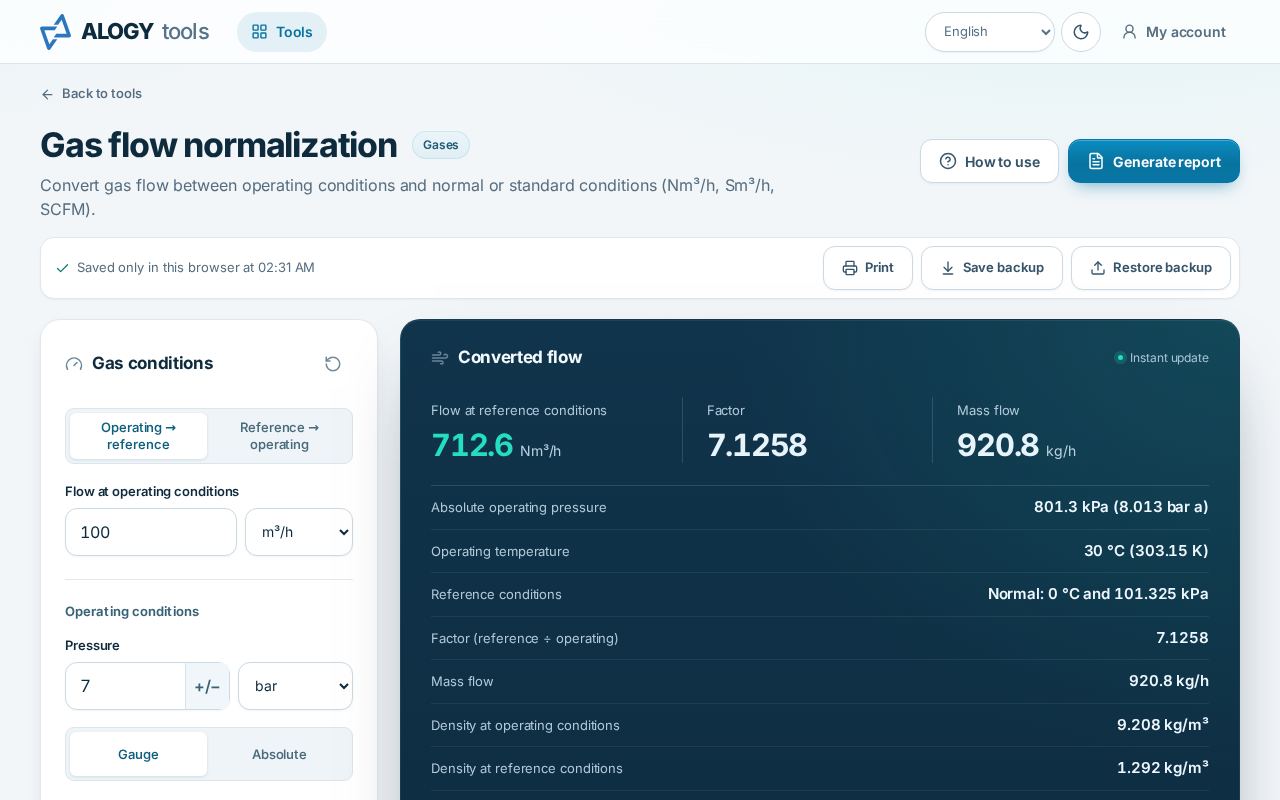
A compressed air flowmeter, installed after the dryer, reads 100 m³/h at line conditions: 7 bar gauge and 30 °C, at sea level. The compressor supplier talks about Nm³/h. How much air is flowing, at normal conditions and by mass?
| Flow measured in the line | 100 m³/h |
|---|---|
| Gauge pressure | 7 bar |
| Gas temperature | 30 °C |
| Atmospheric pressure | 101.325 kPa |
| Gas | Dry air |
| Normal flow (0 °C, 101.325 kPa) | 712.6 Nm³/h |
|---|---|
| Factor reference ÷ operating | 7.1258 |
| Mass flow | 920.8 kg/h |
| Same flow at 20 °C and 101.325 kPa | 764.8 m³/h |
How to read it
The 100 m³/h in the line correspond to 712.6 Nm³/h: compressed to 8.013 bar absolute, the air takes about 7.1 times less volume. By mass, it is 920.8 kg/h. If the contract uses the 20 °C reference, the same air is 764.8 m³/h at 20 °C: check which reference the document uses before comparing numbers.
Limits and cautions
- With Z = 1 the gas is treated as ideal. Natural gas and high pressures need Z computed from the composition (AGA 8 or ISO 12213).
- Atmospheric pressure from altitude uses the standard atmosphere; the day’s barometric pressure varies by a few kPa.
- Gas humidity is not considered: the flow is dry gas, or the humidity stays inside the volume entered.
- The right reference is the one in the contract, meter or manufacturer document; each may use a different one.
Technical basis
Gas law with compressibility factor Z, the usual normal and standard conditions and the ISO 2533 standard atmosphere for altitude.
- DIN 1343 — condição normal (0 °C, 101,325 kPa)
- ISO 13443 — condições de referência padrão para gás natural (15 °C, 101,325 kPa)
- ISO 2533 — atmosfera padrão
In the full version, you can
- Convert both ways with gauge or absolute pressure, altitude and Z.
- Choose among four usual references or enter your own.
- Get mass flow and densities for the listed gases or from the molar mass.
- Export the PDF with the conditions, the result and the reference table.
ALOGY Tools subscription
One plan unlocks every subscription tool, with PDF reports and saving on your device.
- Every subscription tool, in Portuguese, English and Spanish
- Pix, card or boleto on Asaas’s secure page
- 7 days to withdraw with a full refund; after that, cancel renewal whenever you want
Payments in test mode: nothing is charged for now.
Log in to my accountFrequently asked questions
Are Nm³ and Sm³ the same thing?
Not necessarily. Nm³ usually means 0 °C and Sm³ 15 °C or 20 °C, always at 101.325 kPa, but each standard and contract defines its own. Between 0 °C and 20 °C the difference exceeds 7 %.
Can I enter gauge pressure?
Yes. The tool adds the local atmospheric pressure, entered in kPa or computed from altitude.
When do I need the Z factor?
For real gases at high pressure, such as natural gas in transmission lines. For plant compressed air, Z = 1 is usually enough.
Does it help set up a flow computer?
It helps to check one: the tool shows the correction factor between operating and reference conditions, which is what the computer applies from the pressure and temperature measurements.