Gases · safety and environmentSubscription
ppm ↔ mg/m³ converter for gases, with the reference condition stated
Convert gas and vapour concentrations between ppm (by volume) and mg/m³ using the gas molar mass and the reference temperature and pressure. The list has the gases most common in industrial detection, and the molar mass can be typed for any other.
Subscription tool
Read the explanation and the example freely. To use the tool with your own data, log in to an account with active access or subscribe.
Want to check the quality first? Use the 4–20 mA calculator for free
Where it helps at work
- Compare a detector reading in ppm with an exposure limit published in mg/m³.
- Fill in air emission reports that ask for mass concentration.
- Set fixed detector alarms when the procedure comes in another unit.
- Check calibration gas certificates and standard mixtures.
What you enter
What you get
Worked example: carbon monoxide read by a portable detector
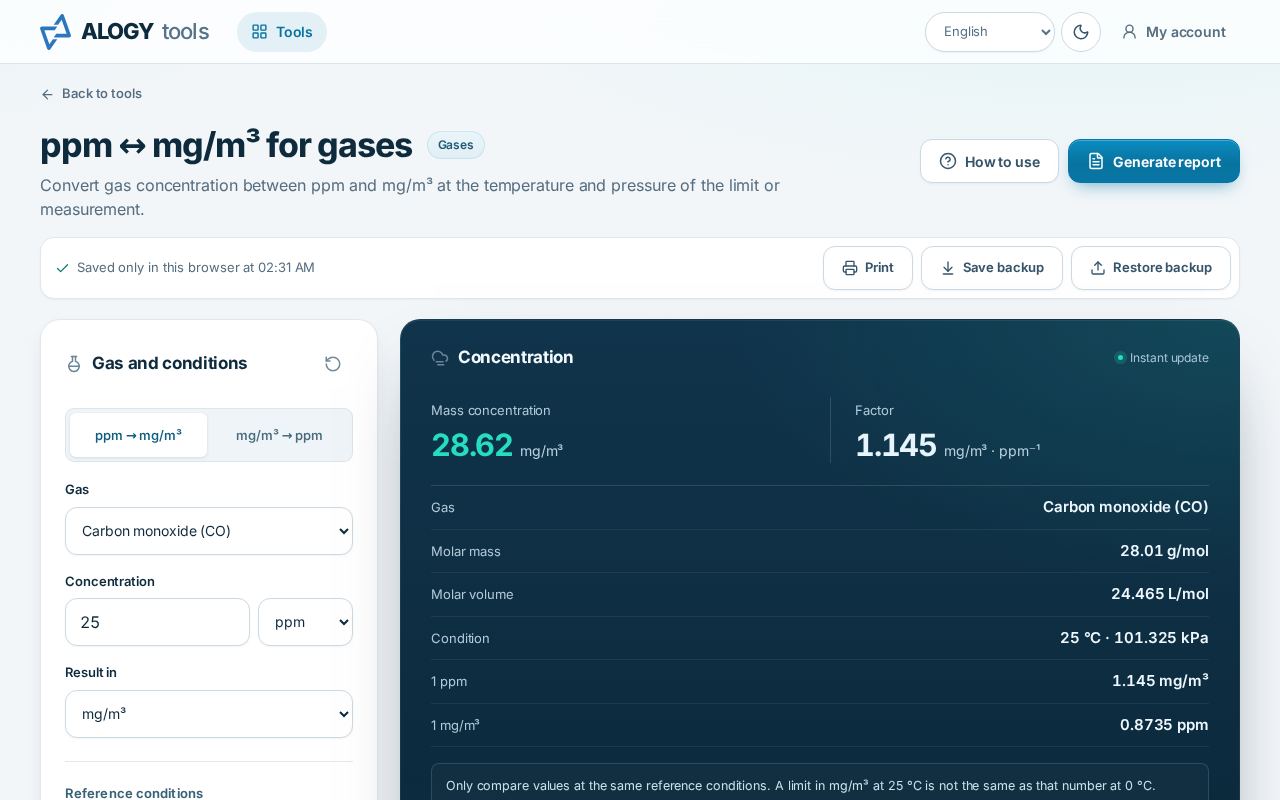
A portable detector reads 25 ppm of carbon monoxide (CO, M = 28.01 g/mol) in a maintenance area. The occupational hygiene report and the emissions spreadsheet ask for mg/m³. What is the mass concentration at 25 °C and 101.325 kPa, the usual condition in occupational hygiene, and how much would it change at 0 °C?
| Gas | CO |
|---|---|
| Molar mass | 28.01 g/mol |
| Reading | 25 ppm |
| Reference condition | 25 °C · 101.325 kPa |
| Mass concentration | 28.62 mg/m³ |
|---|---|
| Conversion factor | 1.145 (mg/m³)/ppm |
| Molar volume | 24.465 L/mol |
| Same value at 0 °C | 31.24 mg/m³ |
How to read it
At 25 °C, each ppm of CO equals 1.145 mg/m³, so 25 ppm correspond to 28.62 mg/m³. At 0 °C the same gas takes less volume and the value rises to 31.24 mg/m³, about 9.2 % more. That is why the result can only be compared with a limit or another measurement stated at the same reference condition.
Limits and cautions
- It applies to gases and vapours diluted in air; aerosols, dusts and mists are not converted this way.
- It does not give exposure limits: use the value and condition of the rule or authority that applies to you.
- Humidity and the dry or wet basis of the sample are not corrected; for emissions, check whether the limit asks for a dry basis and O₂ correction.
- The result is no more accurate than the instrument that took the reading.
Technical basis
Ideal gas, CODATA gas constant and IUPAC molar masses, at the chosen reference condition.
- CODATA 2018 — constante dos gases R = 8,314462618 J/(mol·K)
- IUPAC — pesos atômicos padrão
- NIOSH Pocket Guide to Chemical Hazards — fatores de conversão a 25 °C
In the full version, you can
- Convert any gas in the list, or with your own molar mass, both ways.
- Choose the reference condition or enter the site temperature and pressure.
- Look up the 1 ppm factor for every gas in the list at the same condition.
- Export an unbranded PDF report and keep the work on your device, with a backup file.
ALOGY Tools subscription
One plan unlocks every subscription tool, with PDF reports and saving on your device.
- Every subscription tool, in Portuguese, English and Spanish
- Pix, card or boleto on Asaas’s secure page
- 7 days to withdraw with a full refund; after that, cancel renewal whenever you want
Payments in test mode: nothing is charged for now.
Log in to my accountFrequently asked questions
Why does the same ppm give a different mg/m³ in another table?
Because the table may use another reference condition. At 25 °C the molar volume is 24.47 L/mol; at 20 °C, 24.06; at 0 °C, 22.41. The difference between 0 and 25 °C exceeds 9 %.
Is ppm by volume or by mass?
For gases, ppm almost always means parts per million by volume (or by mole). In liquids and solids ppm is usually by mass, and this conversion does not apply.
Can I use it with gas mixtures?
Yes, by converting each component with its own molar mass. There is no single molar mass for a mixture of pollutants.