Predictive maintenance · vibrationSubscription
Bearing defect frequencies: BPFO, BPFI, BSF and FTF
Calculate the characteristic frequencies of a bearing from its geometry and speed: outer race, inner race, rolling element and cage, in Hz, CPM and orders, with harmonics and a reference spectrum to compare with the vibration measurement.
Subscription tool
Read the explanation and the example freely. To use the tool with your own data, log in to an account with active access or subscribe.
Want to check the quality first? Use the 4–20 mA calculator for free
Where it helps at work
- Identify whether a peak in the vibration spectrum belongs to a bearing and to which part of it.
- Set frequency alarm bands in the analysis software or data collector.
- Review the predictive route when a machine changes bearing or speed.
- Explain the diagnosis to the maintenance team with the calculated numbers.
What you enter
What you get
Worked example: peak in the spectrum of a motor with a 6205 bearing
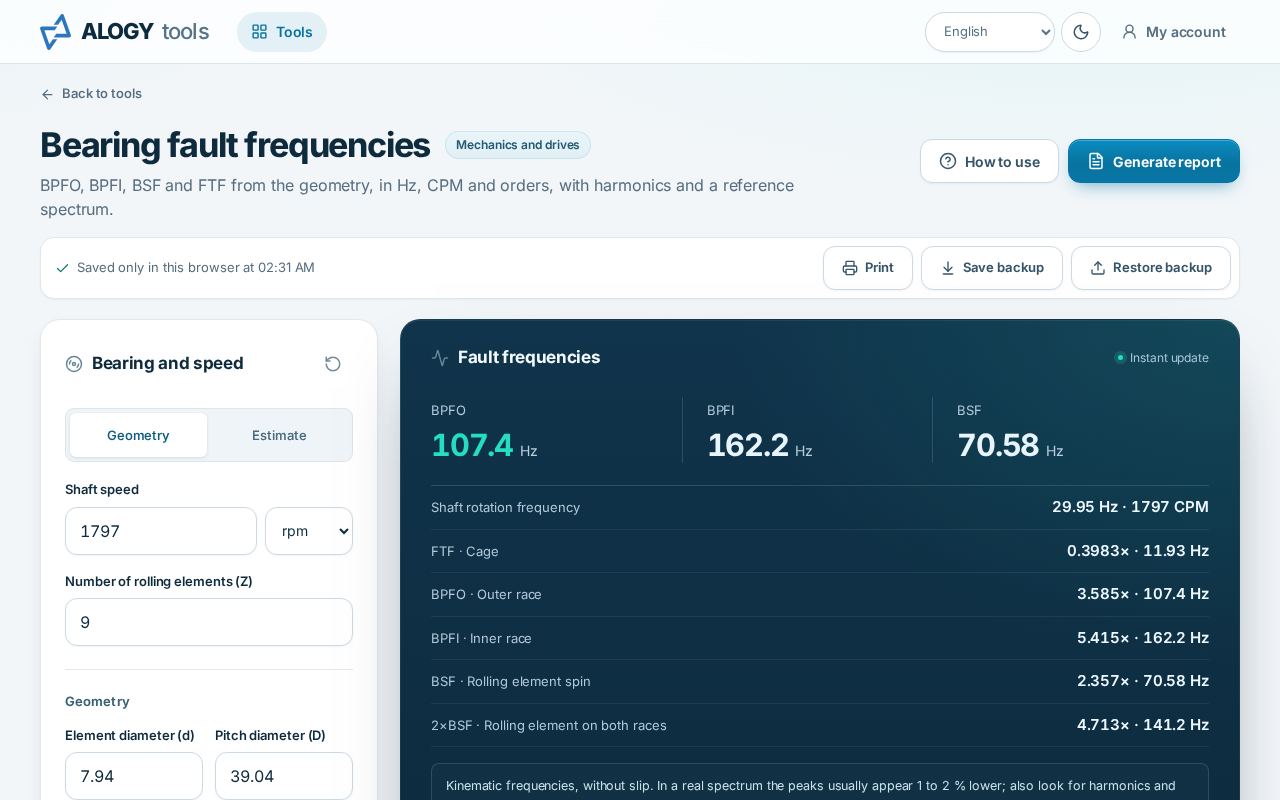
A motor runs at 1797 rpm with a 6205 deep groove ball bearing at the drive end: 9 balls of 7.94 mm, 39.04 mm pitch diameter and 0° contact angle, inner ring rotating. The vibration spectrum shows a peak at 106 Hz with harmonics. Which bearing component does it match?
| Shaft speed | 1797 rpm |
|---|---|
| Rolling elements (Z) | 9 |
| Element diameter (d) | 7.94 mm |
| Pitch diameter (D) | 39.04 mm |
| Contact angle (β) | 0° |
| Rotating ring | Inner |
| BPFO · outer race | 107.4 Hz · 3.585× |
|---|---|
| BPFI · inner race | 162.2 Hz · 5.415× |
| 2×BSF · element on both races | 141.2 Hz · 4.713× |
| FTF · cage | 11.93 Hz · 0.3983× |
How to read it
The shaft frequency is 29.95 Hz. The peak at 106 Hz is 1.3 % below the calculated BPFO, 107.4 Hz (3.585 times the shaft speed), within the usual 1 to 2 % gap caused by slip. BPFO is the ball pass frequency of the outer race: with harmonics, it is the typical pattern of a defect on that race. If the peak were at 162.2 Hz with 29.95 Hz sidebands, the suspect would be the inner race; at 141.2 Hz (2×BSF) with 11.93 Hz sidebands, a rolling element. Confirmation comes from the envelope spectrum and the trend in the next measurements.
Limits and cautions
- Kinematic frequencies, without slip: in the real spectrum peaks usually appear 1 to 2 % lower.
- The geometry must come from the manufacturer; the estimate without geometry can be off by more than 10 % and is not for a conclusive diagnosis.
- It does not analyse the vibration signal nor give severity: diagnosis depends on the spectrum, the envelope and the machine history.
- Tapered roller and angular contact bearings need the real contact angle from the catalogue.
Technical basis
Rolling bearing kinematics without slip, checked against the 6205 bearing published by Case Western Reserve University.
- Case Western Reserve University Bearing Data Center — rolamento 6205-2RS JEM SKF
- Randall, R. B.; Antoni, J. (2011) — Rolling element bearing diagnostics: a tutorial
- ISO 13373 — monitoramento de condição: vibração
In the full version, you can
- Calculate the frequencies of any bearing with the maker’s geometry.
- See Hz, CPM, orders and harmonics in one table.
- Compare the measured spectrum with the reference spectrum drawn by the tool.
- Export an unbranded PDF report and keep the work on your device, with a backup file.
ALOGY Tools subscription
One plan unlocks every subscription tool, with PDF reports and saving on your device.
- Every subscription tool, in Portuguese, English and Spanish
- Pix, card or boleto on Asaas’s secure page
- 7 days to withdraw with a full refund; after that, cancel renewal whenever you want
Payments in test mode: nothing is charged for now.
Log in to my accountFrequently asked questions
Where do I find the bearing geometry?
In the manufacturer’s catalogue or calculation software, by the full bearing code. Many vibration analysis packages already include libraries with these frequencies.
Why work with orders?
Because the order is the multiple of the shaft speed and does not change with it. If the motor has a drive, multiply the order by the new speed to find the frequency.
Which frequency shows first in a defect?
Generally, outer race defects show at BPFO and harmonics; inner race defects at BPFI with 1× sidebands; rolling element defects at 2×BSF with FTF sidebands. Early defects show better in the envelope spectrum.