Mechanics and drivesSubscription
RPM, pulleys and gear reduction: speed, belt and torque
Find the speed a pulley delivers, the pulley diameter to reach a target speed, the belt length and the torque on each shaft. For gear reducers, chain stages and efficiencies and see the output speed and torque.
Subscription tool
Read the explanation and the example freely. To use the tool with your own data, log in to an account with active access or subscribe.
Want to check the quality first? Use the 4–20 mA calculator for free
Where it helps at work
- Change a fan or pump pulley to adjust the flow without changing the motor.
- Check whether a machine’s nameplate speed matches the pulleys actually fitted.
- Estimate the belt length before ordering it from the store.
- Know the torque at a reducer output to size the coupling, shaft or key.
What you enter
What you get
Worked example: belt-driven fan
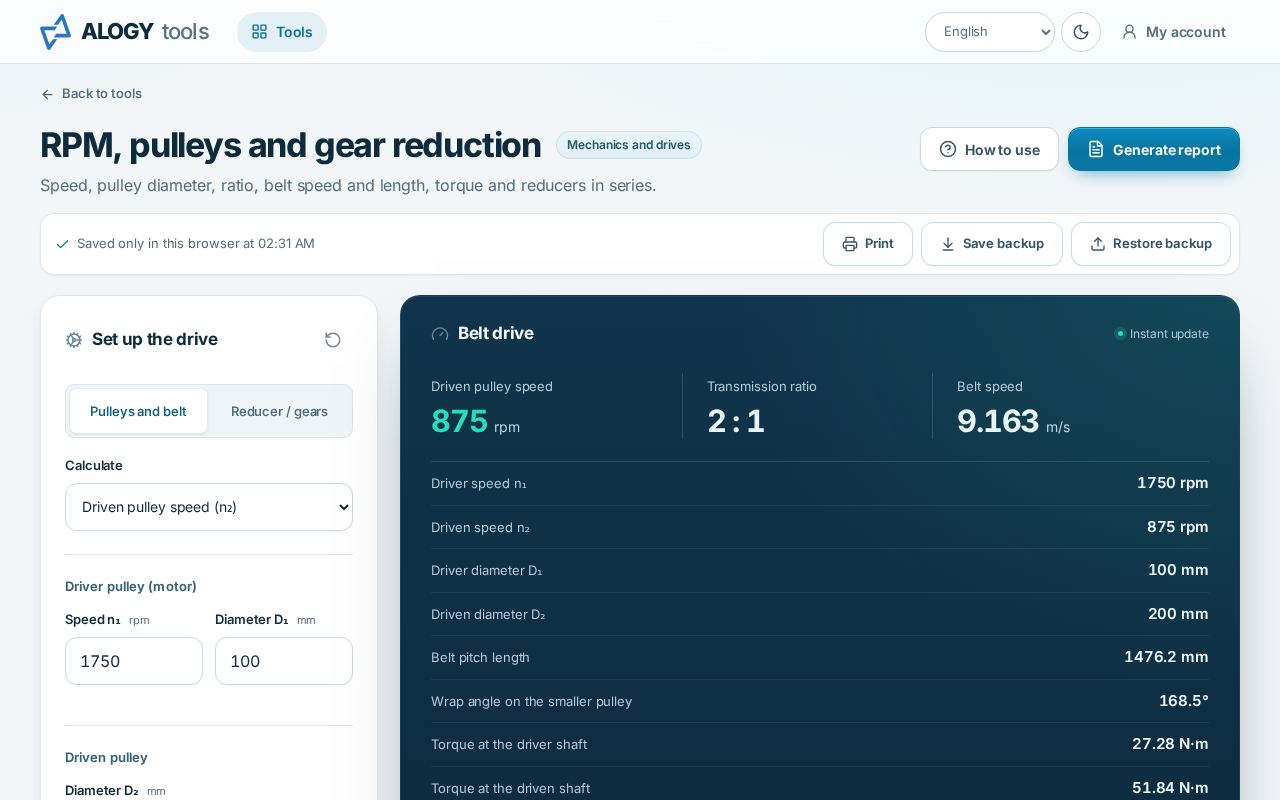
A 1750 rpm motor drives a fan through a V-belt. The motor pulley has a 100 mm pitch diameter and the fan pulley 200 mm, 500 mm apart. The motor delivers 5 kW and the drive efficiency is 95 %.
| Motor speed (n₁) | 1750 rpm |
|---|---|
| Driver pulley (D₁) | 100 mm |
| Driven pulley (D₂) | 200 mm |
| Centre distance | 500 mm |
| Motor shaft power | 5 kW |
| Drive efficiency | 95 % |
| Driven pulley speed (n₂) | 875 rpm |
|---|---|
| Transmission ratio | 2 : 1 |
| Belt pitch length | 1476.2 mm |
| Torque at the driven shaft | 51.84 N·m |
How to read it
The fan turns at 875 rpm, half the motor speed, and receives almost twice the torque (51.84 N·m versus 27.28 N·m). The belt runs at 9.163 m/s, well below the usual 30 m/s limit, and wraps 168.5° of the smaller pulley, above the 120° at which belt capacity starts to drop. The 1476.2 mm pitch length is the starting point to pick the nearest commercial belt in the catalogue.
Limits and cautions
- It does not select the belt section or number of belts, nor the installation tension: that follows the belt maker’s catalogue.
- Bearing loads, service factor and maximum pulley speed are not checked.
- Slip and efficiencies are data you enter; the tool does not estimate them.
- The length is the open-belt pitch length; crossed belts are not covered.
Technical basis
Belt and gear transmission ratios, with the slip and efficiencies you enter, and R20 series diameters (ISO 3).
- Shigley’s Mechanical Engineering Design — correias e transmissões flexíveis
- ISO 3 — números preferenciais (série R20)
In the full version, you can
- Calculate speed, driver diameter or driven diameter with your data.
- See the drive drawn to proportion and the table of nearby standard diameters.
- Build reducers of up to three stages with efficiencies.
- Export an unbranded PDF report and keep the work on your device, with a backup file.
ALOGY Tools subscription
One plan unlocks every subscription tool, with PDF reports and saving on your device.
- Every subscription tool, in Portuguese, English and Spanish
- Pix, card or boleto on Asaas’s secure page
- 7 days to withdraw with a full refund; after that, cancel renewal whenever you want
Payments in test mode: nothing is charged for now.
Log in to my accountFrequently asked questions
Should I use the pulley outside diameter?
No. Use the pitch diameter, where the belt runs. For V-belts it is smaller than the outside diameter; the value is in the pulley catalogue.
How much slip should I enter?
V-belts usually slip 1 to 2 % at rated load. Synchronous (toothed) belts do not slip: use zero.
Does reducing the speed increase the torque?
Yes, in the same proportion as the reduction, minus losses. That is why the shaft and coupling on the slow side must take the higher torque.
Does it work for gears?
Yes, in reducer mode: enter the ratio and efficiency of each stage. The tool multiplies the stages and shows output speed and torque.