Power electricsSubscription
Cable sizing: current, voltage drop and coordination with the protection
Calculate the design current of a three-phase, single-phase or DC circuit, the cable voltage drop with resistance at operating temperature and reactance, the minimum section by the drop limit and the Ib ≤ In ≤ Iz coordination with the breaker.
Subscription tool
Read the explanation and the example freely. To use the tool with your own data, log in to an account with active access or subscribe.
Want to check the quality first? Use the 4–20 mA calculator for free
Where it helps at work
- Check whether the cable of a motor far from the MCC will deliver enough voltage at start and in operation.
- Assess a load increase on an existing circuit without changing the cable.
- Compare copper and aluminium, or parallel cables, for a long feeder.
- Document the voltage drop check of an installation change.
What you enter
What you get
Worked example: feeding a 15 kW motor
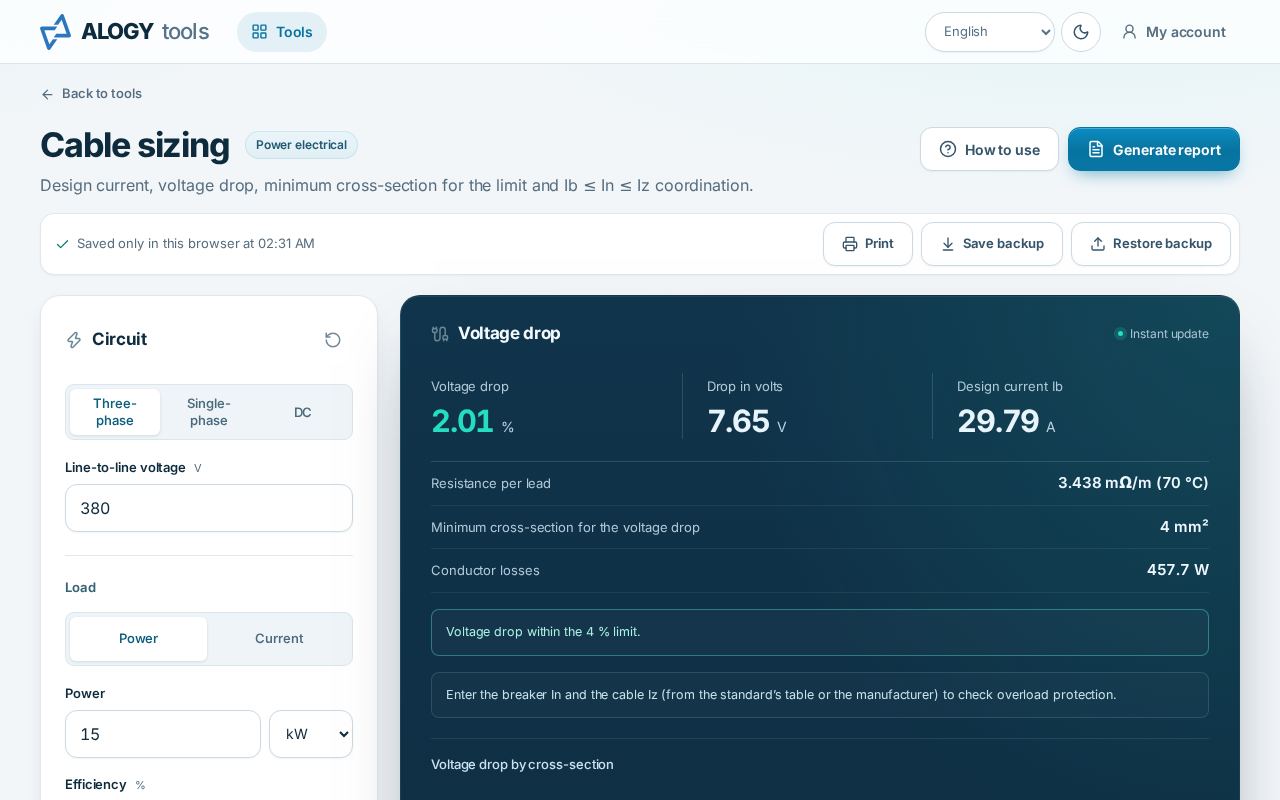
A 15 kW (shaft) three-phase motor, 380 V, power factor 0.85 and 90 % efficiency, is 50 m from the panel. The planned cable is copper, 6 mm², PVC insulation (conductor at 70 °C), with 0.08 mΩ/m reactance. The maximum drop allowed in the circuit is 4 %. Does the cable meet it?
| System | Three-phase |
|---|---|
| Line-to-line voltage | 380 V |
| Shaft power | 15 kW |
| Power factor | 0.85 |
| Efficiency | 90 % |
| Length (one way) | 50 m |
| Conductor | Copper · 6 mm² · PVC 70 °C |
| Drop limit | 4 % |
| Design current Ib | 29.79 A |
|---|---|
| Voltage drop | 7.649 V |
| Voltage drop (%) | 2.01 % |
| Minimum section by voltage drop | 4 mm² |
| Conductor losses | 457.7 W |
How to read it
The design current is 29.79 A. With 6 mm² the drop is 7.649 V, or 2.01 % of the voltage, below the 4 % limit. By voltage drop alone, the smallest section would be 4 mm², but that is not enough to choose the cable: the current-carrying capacity Iz for the installation method comes from the IEC 60364-5-52 (NBR 5410) table or the manufacturer. Entering the breaker In and that Iz, the tool checks Ib ≤ In ≤ Iz. Conductor losses add up to 457.7 W.
Limits and cautions
- It does not calculate the current-carrying capacity Iz: it depends on the installation method, grouping, ambient temperature and insulation, and comes from IEC 60364-5-52 (NBR 5410) or the manufacturer.
- Short circuit, shock protection, neutral and protective conductor sections, harmonics and motor starting drop are not included.
- The reactance is a typical value you enter; check it in the cable catalogue.
- It does not replace the electrical design signed by a qualified professional.
Technical basis
Design current and voltage drop with temperature-corrected resistance (IEC 60228) and reactance; coordination with the protection per IEC 60364 / NBR 5410.
- ABNT NBR 5410 — instalações elétricas de baixa tensão
- IEC 60364-5-52 — seleção e instalação de linhas elétricas
- IEC 60228 — condutores de cabos isolados
In the full version, you can
- Check three-phase, single-phase and DC circuits from power or current.
- Compare copper and aluminium, insulations and parallel cables.
- See the drop for each commercial section and check Ib ≤ In ≤ Iz with the Iz from the standard.
- Export an unbranded PDF report and keep the work on your device, with a backup file.
ALOGY Tools subscription
One plan unlocks every subscription tool, with PDF reports and saving on your device.
- Every subscription tool, in Portuguese, English and Spanish
- Pix, card or boleto on Asaas’s secure page
- 7 days to withdraw with a full refund; after that, cancel renewal whenever you want
Payments in test mode: nothing is charged for now.
Log in to my accountFrequently asked questions
Is the length out and back?
No. Enter only the one-way length. The factor k already accounts for the return: √3 in three-phase and 2 in single-phase and DC.
Why can the cable still be wrong if the drop passed?
Because voltage drop and current-carrying capacity are different checks. Short cables with high current are usually decided by Iz; long cables, by the drop. Both must be met.
Which drop limit should I use?
It depends on the circuit and the origin of the installation. IEC 60364-5-52 and NBR 5410 give limits for final circuits and from the supply point; use the value for your case.